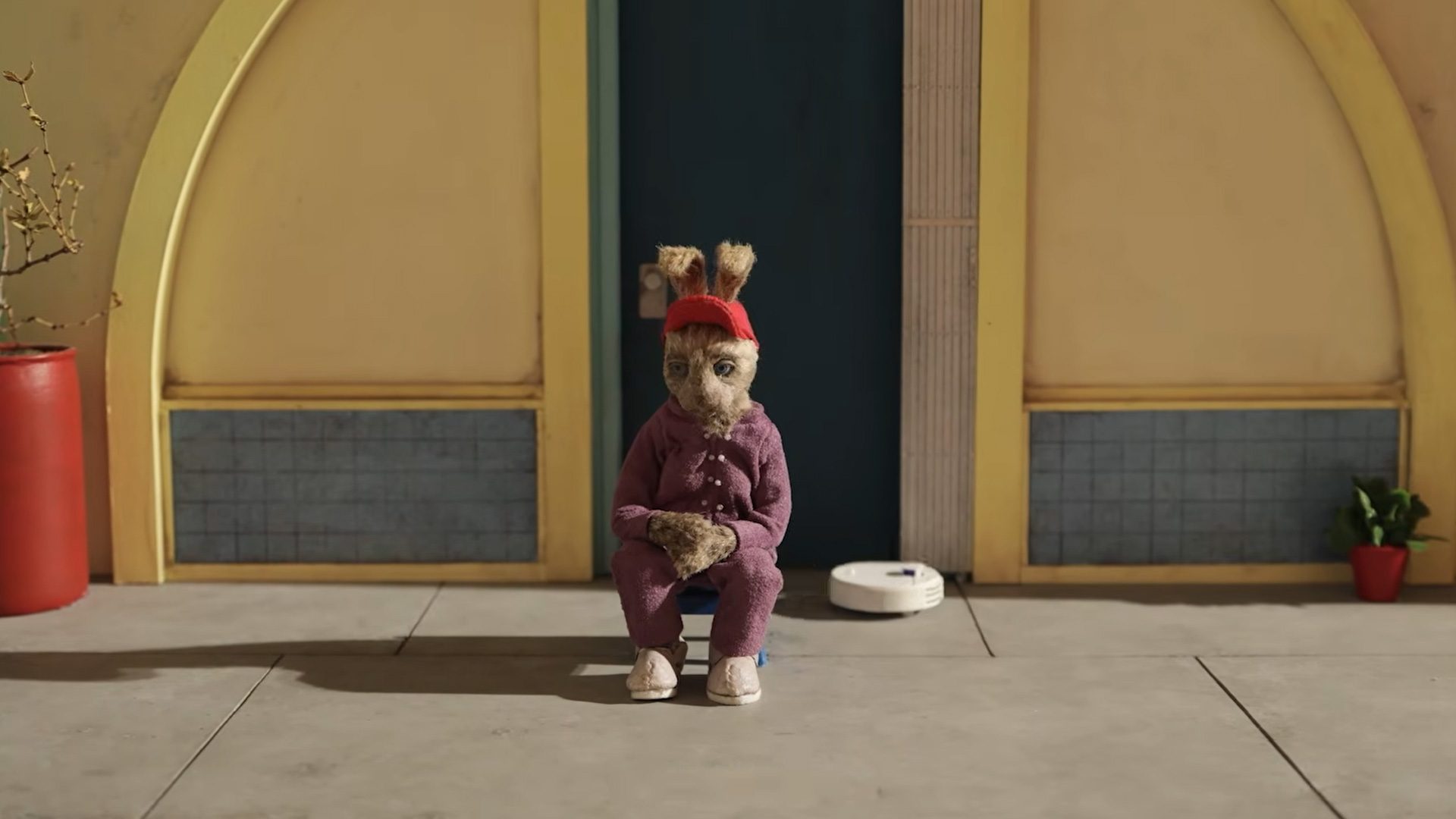

A robotic vacuum, two elderly rabbits, and a handful of oranges don’t sound like the ingredients for an emotional story. Yet Tennis, Oranges transforms these unlikely elements into one of the most quietly affecting animated shorts in recent years.
Written and directed by Sean Pecknold, the stop-motion film follows a lonely hospital cleaning robot. Its routine is interrupted when it meets an elderly rabbit living on the streets of Los Angeles’ Chinatown. What begins as a simple encounter gradually unfolds into a gentle meditation on aging, friendship, purpose, and the comfort found in small acts of connection.
Premiering at the 2024 SXSW Film & TV Festival, the film continued its successful festival run at Annecy, Ottawa, AFI, and Seattle before winning Best Animated Short at the New Hampshire Film Festival.
The Poetry of Repetition
The story grew from Pecknold’s own experiences working alongside his wife and production designer, Adi Goodrich, in an art space on Chungking Road in Los Angeles’ Chinatown. Watching the neighborhood’s daily routines inspired a film about repetition, dignity, and the unexpected relationships that quietly shape our lives.
That sense of routine extends to the film’s visual language. Pecknold combines stop-motion animation with techniques more often associated with live-action cinema, using naturalistic lighting, expressive camera movement, and richly detailed miniature sets. The result feels handcrafted without becoming nostalgic.
Perhaps the film’s most memorable character is the little robot vacuum. Stripped of a face and relying almost entirely on movement, it somehow becomes deeply expressive. Its gentle curiosity makes it surprisingly easy to forget you’re watching a household appliance.
Circles That Bring Us Together
Pecknold has described Tennis, Oranges as an exploration of loneliness, community, and the comfort found in recurring patterns. Circular imagery appears throughout the film, from tennis balls and oranges to ceiling fans and planets, suggesting that repetition can offer reassurance rather than monotony.
That quiet philosophy gives the film its emotional weight. Instead of searching for dramatic revelations, Tennis, Oranges finds meaning in ordinary encounters and shared moments of stillness.
Like the gentle rhythm that carries it from beginning to end, the film reminds us that even the smallest connections can keep loneliness from becoming permanent.