Max Lehman’s Strange and Wonderful Worlds
Elliott Brooks
Written by Elliott Brooks in Dimensions Art & Design Sculpture

Max Lehman’s Strange and Wonderful Worlds

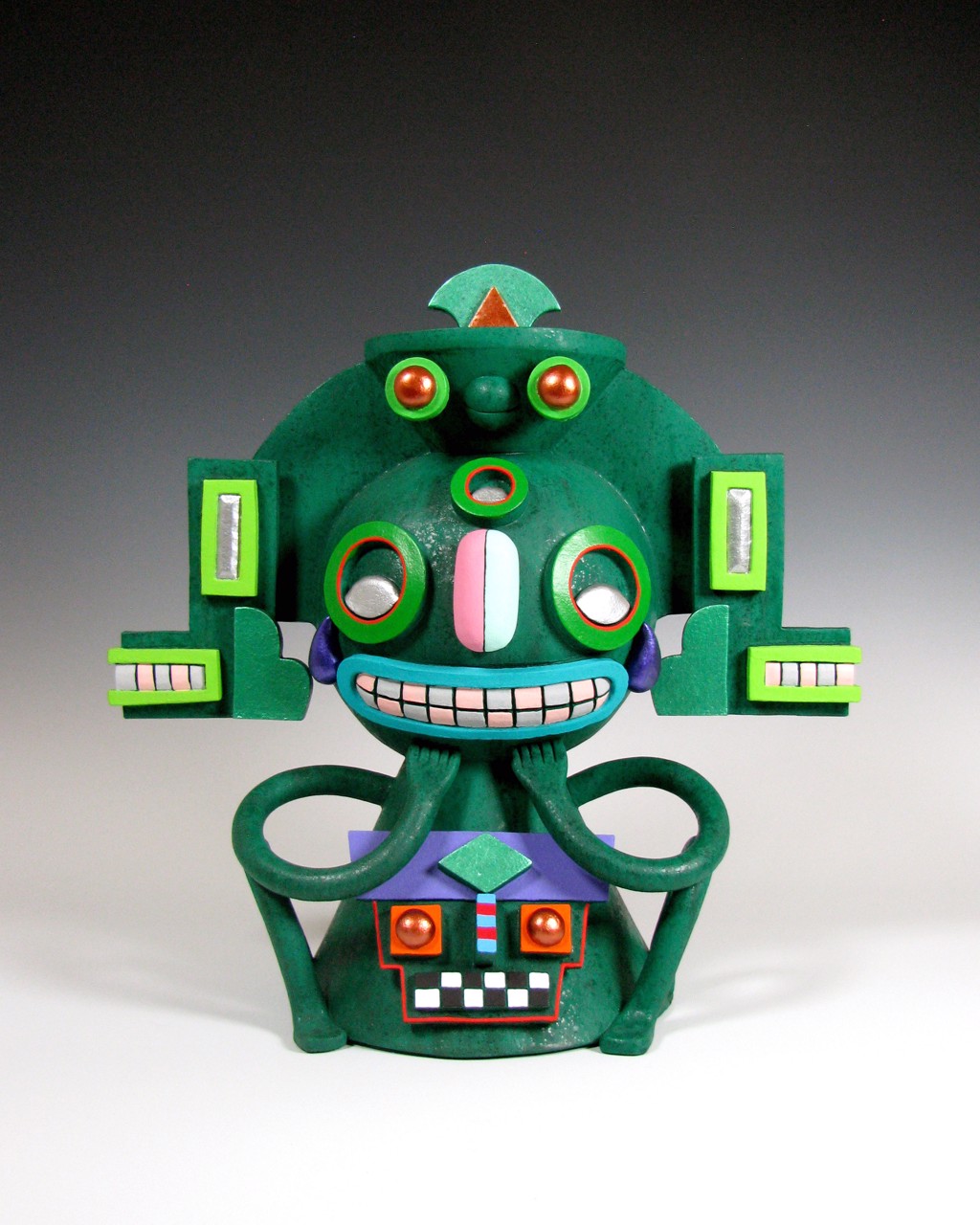
Max Lehman’s sculptures look like they might have wandered out of an ancient temple, a science fiction movie, or a particularly strange toy box. Sometimes, it’s hard to tell which. The New Mexico-based ceramic artist has spent decades building a visual universe where Pre-Columbian imagery, pop culture, punk rock, and a healthy dose of cosmic curiosity happily collide.

His work can be funny, colorful, and a little unsettling, often all at once. Look closer, though, and there’s more going on than quirky characters and unusual shapes. Lehman is interested in the big questions: how we perceive reality, what lies beyond what we can see, and whether the past and future might have more in common than we think.

A Childhood Fascination That Stuck

Lehman’s interest in ancient Mexican civilizations began when he was a child. A Mexican babysitter told him stories about Indigenous peoples, stone cities, and a calendar. His mother later bought him a book about the ancient cultures of Mexico, setting him on a path that would eventually become a lasting influence on his art.

After moving to Arizona with his family in 1973, Lehman was closer to Mexico and its history. Trips across the border and a visit to the Yucatán helped deepen that connection. Today, his interests stretch well beyond Mesoamerica, taking in cultures from South America, Oceania, and ancient China. He sees intriguing visual connections between them, even if the questions they raise don’t always come with easy answers.

Max Lehman. Magda Magenta Made Multiple Time Warps with Maddening Mauve Manifestations of Orphic Ophidians
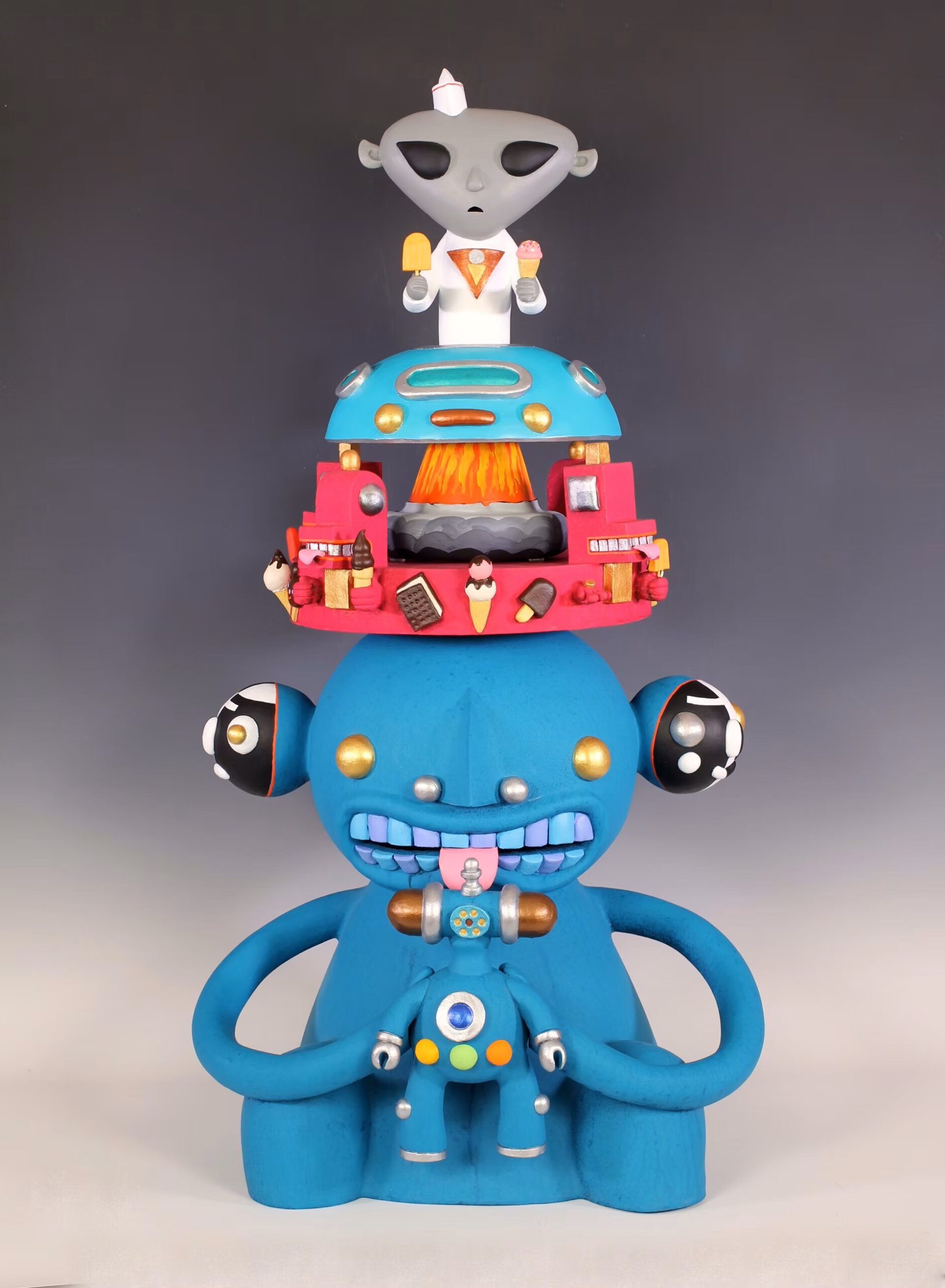
Max Lehman. Toothy Terry Toyed With His Android While Anxiously Awaiting The Arrival Of The Ice Cream Alien
Punk Rock in the Pottery Studio

Lehman studied intermedia at Arizona State University, working with installation, performance, multimedia, and video rather than focusing exclusively on traditional studio art. Punk rock was taking off, and its energy found its way into his work, particularly in the colors and attitude.

Ceramics came later through apprenticeships, where he learned to build large hollow forms. He eventually developed a way of working that puts the idea ahead of the material. Clay is his main tool, but he isn’t precious about process. Paint, neon, digital media, and installation can all enter the picture if they help bring a piece to life.

The Past Has a Future

Lehman’s latest exhibition Ancestral Androids brings ancient visual culture into conversation with futuristic technology. The result feels less like a history lesson than a transmission from an alternate timeline, where old civilizations and machines somehow share the same world.

His influences are just as eclectic. Alongside Pre-Columbian art, he draws from artists such as Mark Ryden, Kenny Scharf, Todd Schorr, and Keith Haring, as well as the music and imagery that shaped his younger years. It’s an unusual mix, but that’s precisely the point. Lehman isn’t interested in keeping artistic categories neatly separated.

Max Lehman. The Malachite Mage
Max Lehman. Bug Eyed Bixley Benevolently Believed his Blue Begonias Bloomed Beautifully
Welcome to Kandlythane

For years, Lehman has been imagining an extragalactic civilization called Kandlythane, located eleven million light-years from the Milky Way. It has its own history, cultures, and inhabitants, and he wants to bring this sprawling fictional universe to life through sculpture, illustration, graphic novels, and digital work.

The idea brings together many of his interests, from science fiction and imaginary landscapes to questions about consciousness and dimensions beyond our own. Think of the elaborate worlds of Oz, Narnia, or Dune, translated into a visual language that feels distinctly his. The galaxy isn’t just a backdrop. It’s a place with a history of its own.

After more than thirty years working with clay, Lehman continues to experiment with forms and surfaces rather than settling into a fixed formula. His sculptures invite a double take: they’re playful enough to make you smile, but strange enough to leave you wondering what you’re actually looking at.

Perhaps that’s what makes his work so engaging. It doesn’t insist on explaining every mystery or tying every idea into a neat bow. Instead, Lehman gives us a glimpse of worlds that feel both unfamiliar and oddly recognizable, then leaves us free to explore. You don’t need a degree in astrophysics or archaeology to join him. Curiosity will do just fine.

Max Lehman. Cosmotropolis
Scroll