Where Labor Becomes Landscape: Reave Dennison at Pale Fire
Zoë Marin
Written by Zoë Marin in Beyond the Frame Creative Photography

Where Labor Becomes Landscape: Reave Dennison at Pale Fire

Work leaves traces

Not just in the body, but in the land — in the surfaces of things, in the quiet accumulation of effort over time. In Reave Dennison: Tree Work, labor is not staged or observed from a distance. It is lived, embedded, and carried into the image with a kind of quiet familiarity.

Dennison, a photographer and gelatin silver printmaker based on Mayne Island in British Columbia, documents maritime and forestry labour in the Pacific Northwest. But what sets his work apart is proximity. He is not simply photographing these environments — he is part of them, moving within the very systems he captures as a beachcomber, sawyer, arborist, and tugboat crew member.

Reave Dennison. LS 4120, 2025
Reave Dennison. Adam the Arborist, 2024
Inside the rhythm of the work

That closeness is immediately visible. His photographs feel unguarded, shaped less by observation than by participation. There is no distance between subject and photographer — only the shared conditions of weather, exhaustion, repetition, and skill.

“In those moments of exhaustion,” he has said, “you can get the most honest photographs.” And that sentiment carries through the work, where the camera seems to appear almost incidentally, as if it were simply another tool carried through the day.

A landscape of labor

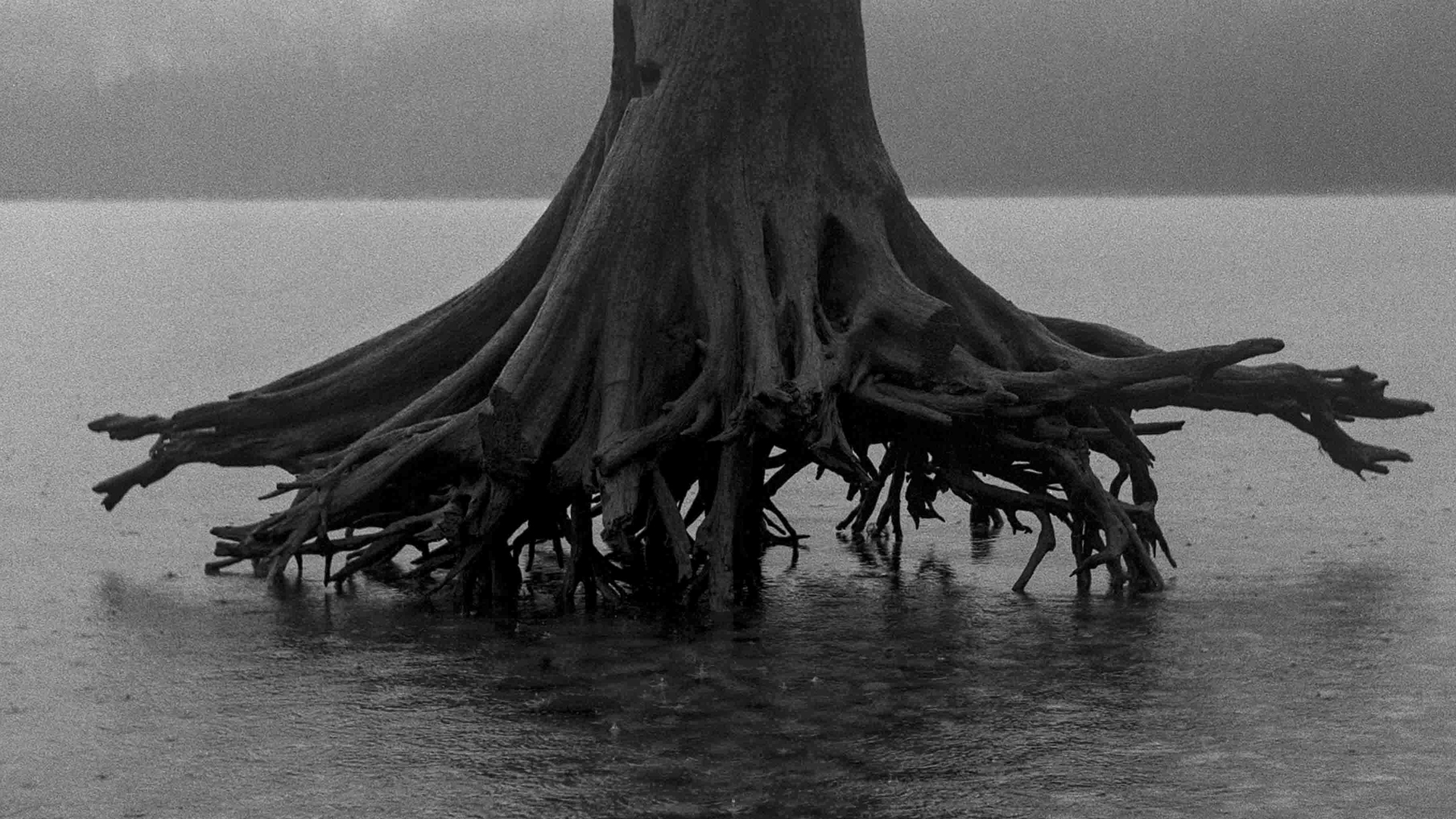
At Pale Fire gallery in Vancouver, Reave Dennison: Tree Work brings together a selection of black-and-white analogue photographs taken over the past five years. The exhibition unfolds across three interconnected bodies of work: beachcombing, sawmill culture, and arborist labour.

Each reflects a different facet of an industry that remains central to British Columbia’s economy, yet often invisible in its daily realities. Dennison’s images move through these spaces with attentiveness, revealing not spectacle but the quiet precision of work as it unfolds.

Reave Dennison. Cutblock 2, 2025
Reave Dennison. Luke, 2023
What remains, what changes

A shoreline overtaken by driftwood. A log grader marking timber inside a mill. An arborist suspended mid-task, carefully dismantling a fallen tree. These are not dramatic moments, but precise ones — small gestures that reveal the complexity and skill embedded within physical labour.

And yet, a broader reflection on change begins to emerge. Forestry, like many industries, is in transition: technologies evolve, regulations shift, and long-standing practices begin to disappear. Beachcombers grow fewer as costs rise, while tugboats are retired in favor of larger, more efficient vessels — reshaping not only the work itself, but the knowledge it carries.

The weight of making

Materiality plays a crucial role in how these ideas are conveyed. Dennison works entirely with analogue processes, shooting on film and developing his prints in a darkroom he built himself. Even the frames are handmade, constructed from salvaged wood.

Because of this, the physicality of the work mirrors its subject matter. Nothing feels detached or purely representational — each image carries the weight of its making, echoing the labor it depicts.

Reave Dennison. Broken Big Saw, 2025
Reave Dennison. Garden Girl, 2019
Extending the work

This attention to process extends beyond the exhibition itself. Tree Work coincides with the release of Dennison’s first photography book, Under 60 Tons, produced in collaboration with Information Office.

The book gathers photographs taken while working aboard small tugboats — vessels now being phased out as regulations tighten and industries modernize. In that sense, it continues the exhibition’s reflection on a world in transition, where human skill and manual labor are increasingly shaped by technological change.

Holding the present

And yet, what stays with you in Dennison’s photographs is not a sense of loss, but of attention. The steady concentration of a worker. The texture of wood, water, and machinery. The quiet persistence of people who continue to move through these environments, even as they shift around them.

There is no attempt to dramatize or resolve what is changing. Instead, the work remains anchored in the present — in the gestures, materials, and moments that might otherwise pass unnoticed. For those drawn to photography that moves beyond observation into lived experience, Tree Work offers a compelling and grounded perspective. For more information about the exhibition, visit the exhibition website.

Reave Dennison, Tree Work, 2026, Pale Fire. Photo: NK Photo
Scroll