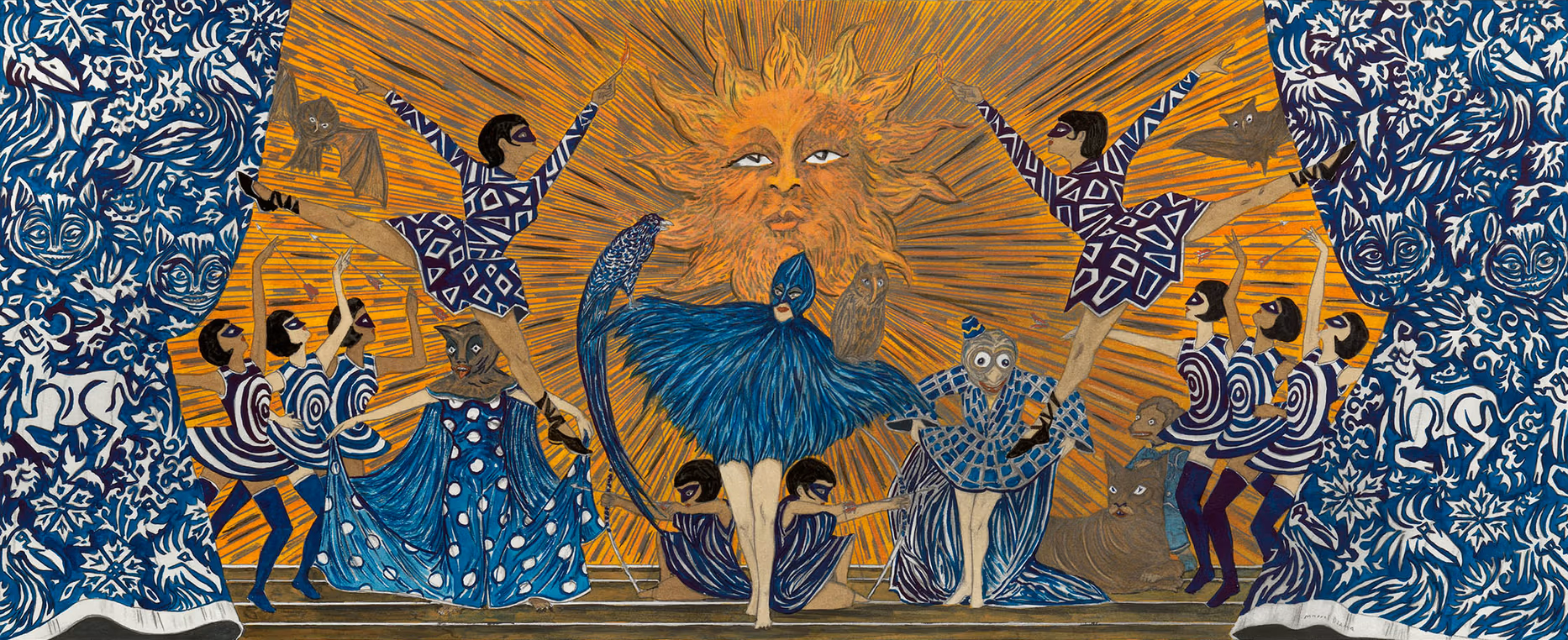
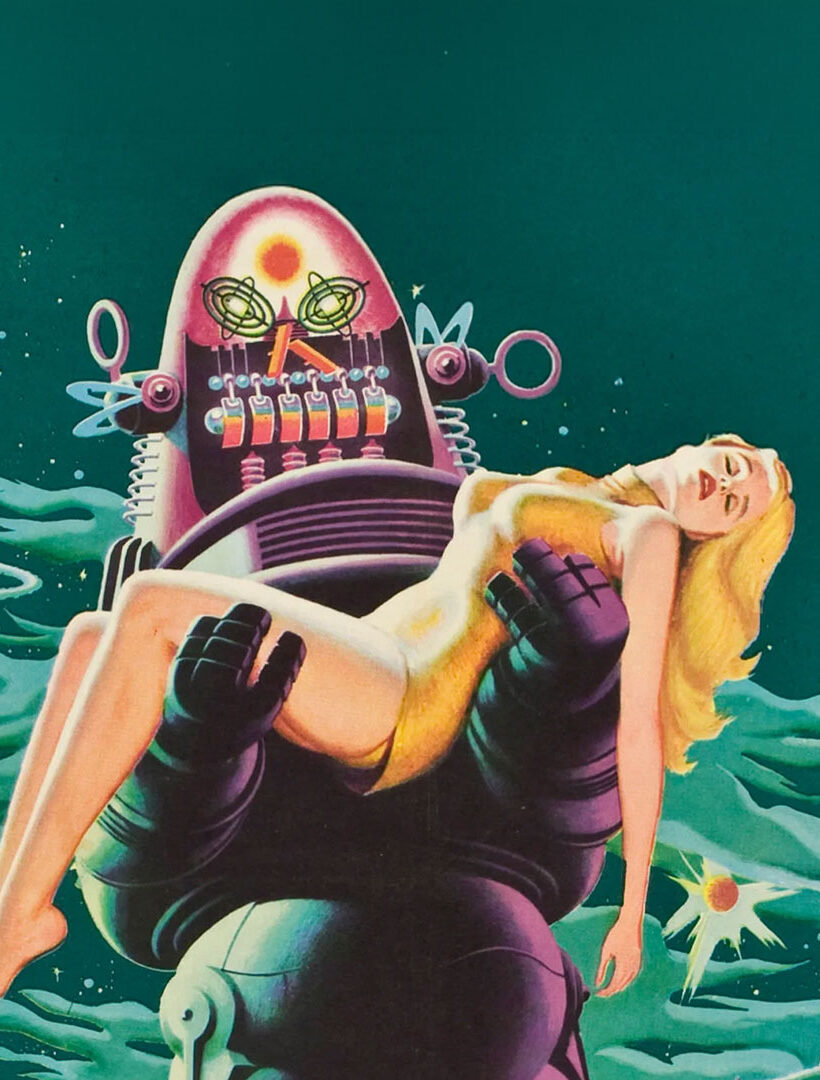
There’s an unmistakable rhythm to Marcel Dzama’s work — a beat that moves between whimsy and menace, play and unease, storytelling and speculation. Born in Winnipeg in 1974, Dzama has spent more than two decades cultivating a visual language that combines fairy-tale imagery with dream logic, folklore, performance, and art-historical reference. Though his characters can feel deceptively simple — masked dancers, hybrid animals, coyotes by moonlight — they occupy worlds that are richly layered, emotionally charged, and full of suggestion.


Written by
Elliott Brooks
in
Dimensions
Art & Design
Creative
Marcel Dzama — Storybook Surrealism in Motion
Dzama first trained at the University of Manitoba, where he earned his BFA and co-founded the Royal Art Lodge, a collaborative drawing collective that emphasized imagination, improvisation, and shared visual invention. That formative experience — drawing with peers, playing with narrative, and embracing the spontaneous — laid the groundwork for a practice that refuses easy categorization. It’s not just drawing; it’s storytelling, world-building, and performance packed into two-dimensional form.
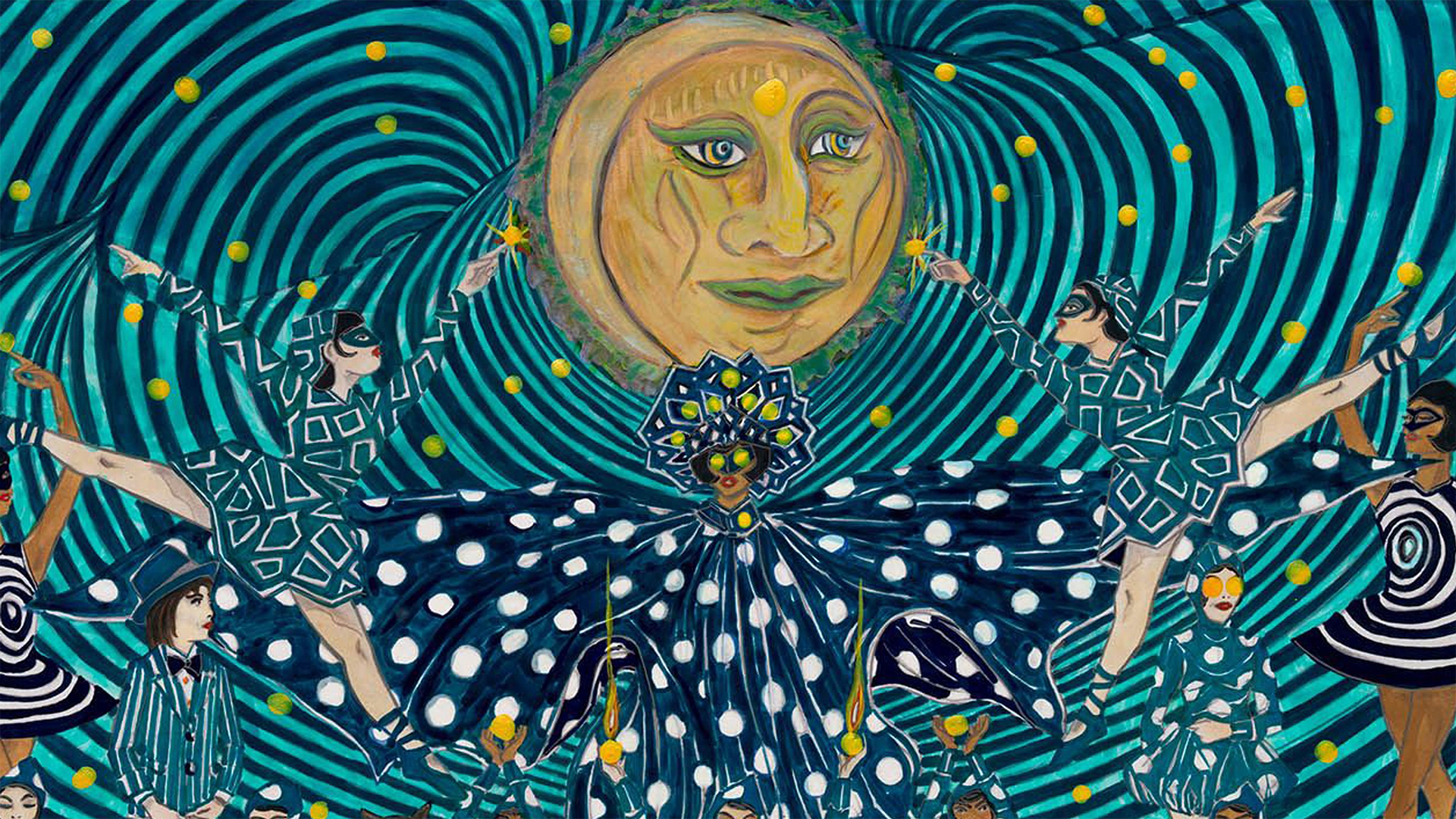
Throughout his career, Dzama has drawn inspiration from sources as varied as folk tales, early cinema, surrealist cinema, and literary lore. His visual motifs — moons with mischievous grins, dancing figures, trees and beasts that seem part human — recall the pleasures of fairy tales while flirting constantly with darker undertones. These are places where innocence and threat walk side by side, where merriment might hide a deeper anxiety about our own world. This duality is a guiding force in his work, much like the contrast between light and dark in folklore, or between circus performance and somber ballad.
His exhibition Child of Midnight, shown at David Zwirner in London, brings many of these elements into focus. Here, figures and anthropomorphized animals gather beneath luminous moons and galaxies of stars, their scenes lush with color and motion. Although fantastical, the imagery carries a real weight: the exhibition reflects on the climate crisis, suggesting that the whimsical aquatic ballets and moonlit revels may be on the brink of ecological peril. This blend of beauty and warning — escapism mixed with a sense of urgency — is quintessential Dzama: playful at first glance, thought-provoking upon reflection.
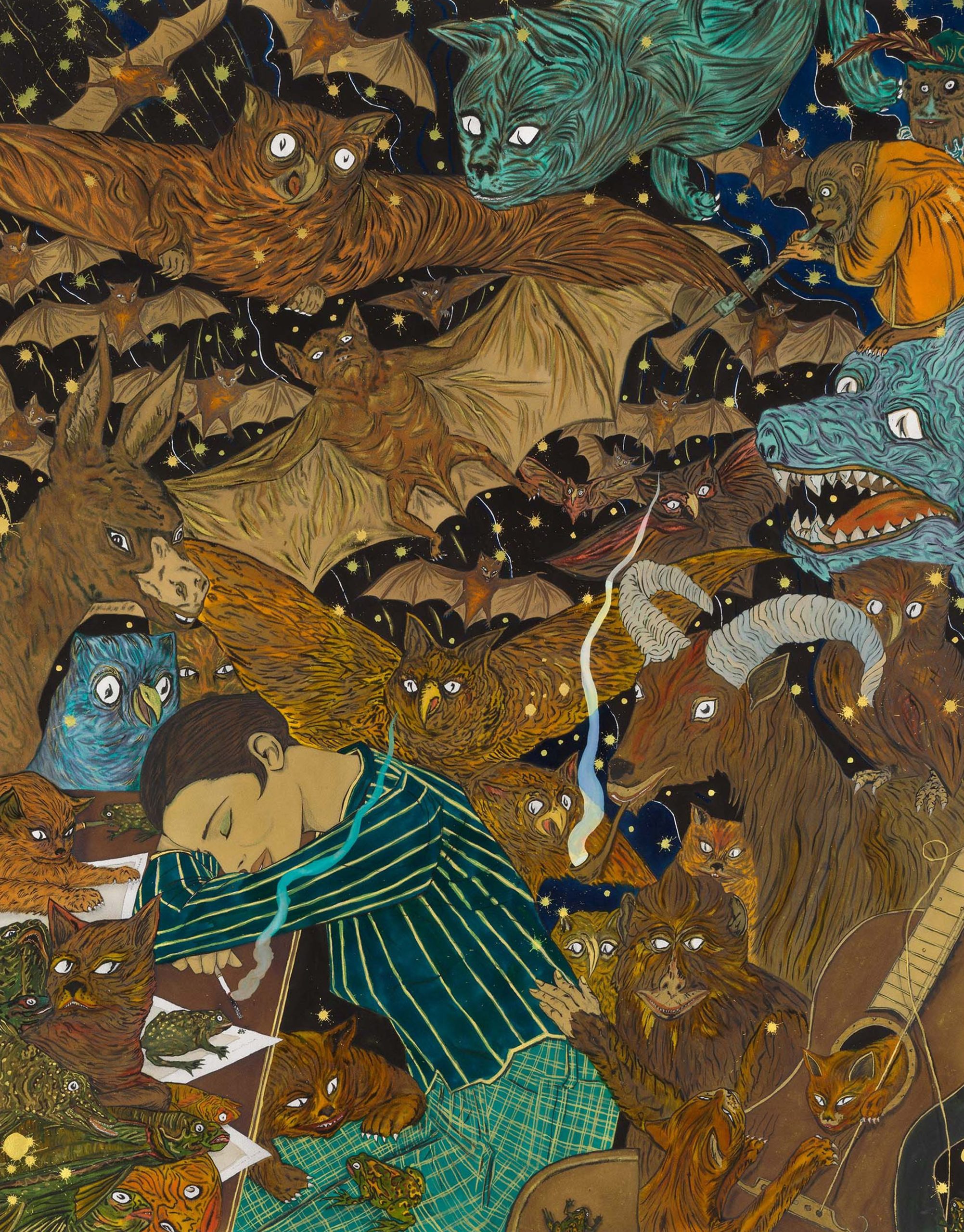
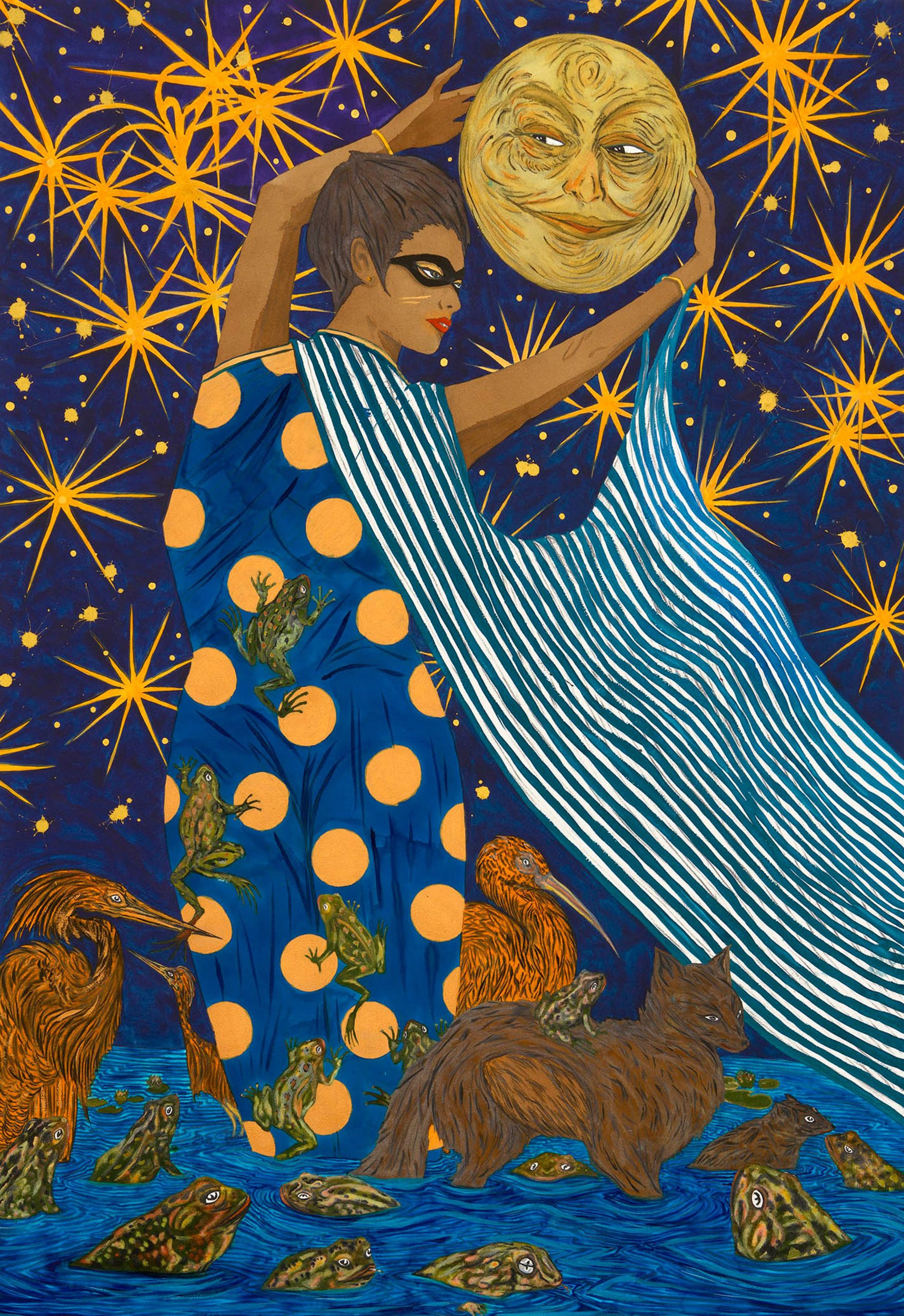
Beyond the gallery, Dzama’s work continues to evolve. A major Canadian show titled Ghosts of Canoe Lake brings his fantastical language into dialogue with the country’s artistic legacy. Drawing on imagery tied to the wilderness and landscapes that have defined Canadian art for generations, this work refracts those themes through Dzama’s own surreal optic, mixing dancing animals and whimsical figures with echoes of regional mythology and environmental anxiety. The result feels like a conversation between memory, history, and personal imagination — a subtle but profound meditation on ecology and culture.
Dzama’s imagination doesn’t stay confined to the page. His practice includes film, sculpture, costumes, puppetry, and performance, all of which enrich his visual narratives and blur the line between illustration and theater. He occupies a singular space in contemporary art — part storyteller, part dream-architect, part choreographer of images that feel both theatrical and eerily real. Whether referencing chess games, mythic cycles, or the simple act of a moonlit dance, his work always feels alive, as though it has been whispered into existence before being committed to ink.
A consistent thread across Dzama’s career is this: he invites you into worlds that don’t explain themselves, but rather suggest — a twist here, a moonlit grin there — and then trust that you’ll fill in the rest. In an age dominated by spectacle and speed, his paintings and drawings reward the slow gaze, the thoughtful journey through image and implication. There’s a magic there — not the glittery kind, but the quiet magic of stories that never quite let go, of pictures that haunt like a half-remembered dream.
For anyone attracted to places where narrative and visual inventiveness intertwine, Marcel Dzama’s work is an invitation to keep looking — to embrace mystery and to find delight in the unexpected pathways between reality and reverie.
All images from davidzwirner.com.