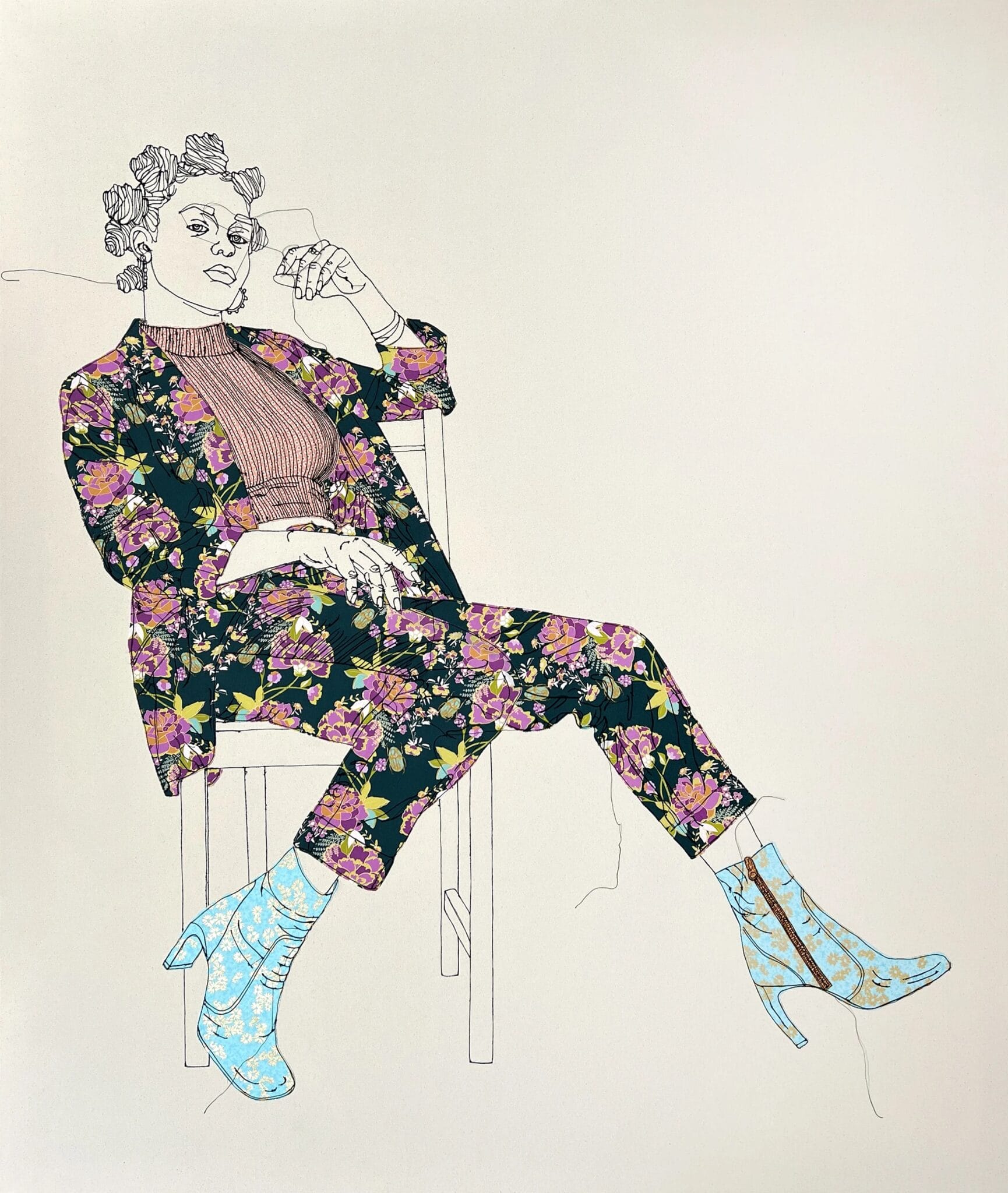
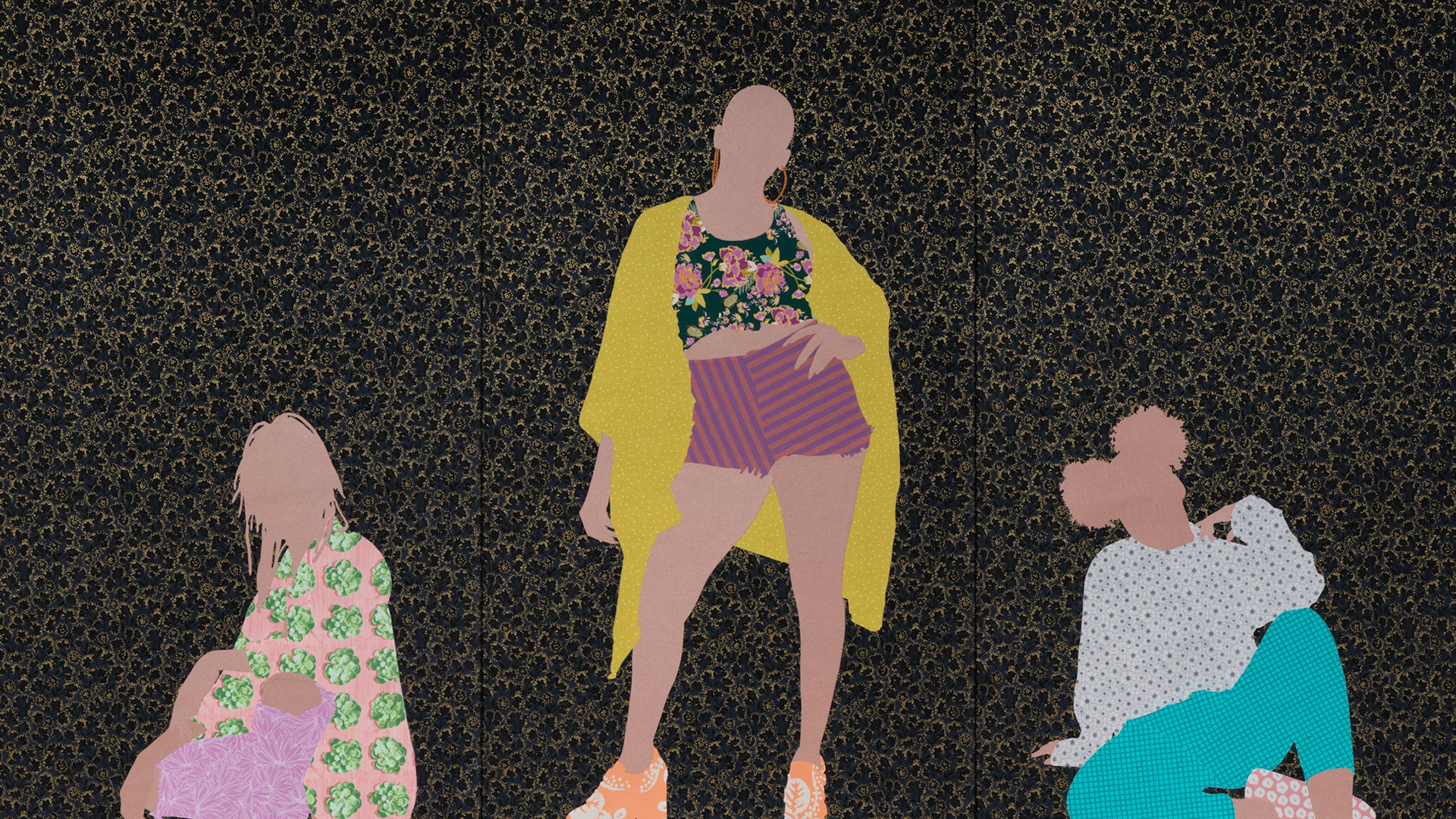
Gio Swaby works with materials that already carry meaning. Fabric, thread, and stitching—techniques long associated with domestic labor and care—form the backbone of her large-scale portraits. From a distance, her figures read through color and composition; up close, they reveal themselves as meticulously sewn constructions, shaped by time, touch, and intention. Rather than mimicking painting, Swaby treats textile as a fully formed visual language, using process itself to speak about identity, presence, and self-definition.


Written by
Elliott Brooks
in
Dimensions
Art & Design
Creative
Stitched Into Being — The Tender Power of Gio Swaby
Born and raised in Nassau, Bahamas, and now based in Toronto, Swaby’s relationship with textiles began early. She learned to sew from her mother, a seamstress, and that practical knowledge became foundational to her artistic thinking. What might have remained a private, domestic skill evolved into a public practice—one that brings embroidery, appliqué, and quilting firmly into contemporary art spaces without shedding their histories.
At the core of Swaby’s work is an engagement with Black feminist thought and an understanding of love as both subject and method. Her portraits frequently depict Black women from her own life—friends, peers, and herself—rendered at or near life size. These figures are not idealized or performative. Clothing, gesture, and color function as extensions of character, allowing each subject to occupy space with clarity and self-possession.
This approach came into sharp focus with Fresh Up, her first major museum exhibition. The title draws from a Bahamian expression used to compliment someone’s style or presence, and the works reflect that spirit of affirmation. Each portrait begins with a photoshoot in which Swaby invites her sitters to arrive as they are, wearing what feels most true to them. Those moments are then translated into layered textile portraits whose scale and color insist on attention while remaining deeply personal.


One of the most distinctive aspects of Swaby’s practice is her decision to reveal what is usually concealed. Many works present the reverse side of the canvas, leaving knots, seams, and loose threads visible. By doing so, she resists the idea of a polished, finished surface. Process becomes part of the image, and vulnerability is framed not as a weakness, but as a necessary condition of growth and self-understanding.
That philosophy is explored more intimately in I Will Blossom Anyway, a series of self-portraits that turns inward while maintaining emotional openness. Here, Swaby works with restrained palettes and delicate stitched lines, allowing figures to emerge through suggestion rather than density. The title reflects a quiet insistence on growth—one that persists alongside grief, change, and uncertainty, rather than in spite of them.
As Swaby’s work has reached wider audiences through museum exhibitions, collections, and critical attention, its grounding in care and intention has remained constant. Her rise within contemporary art has been marked not by spectacle, but by consistency—a clear commitment to material, subject, and process.
Swaby’s work continues to grow outward, finding new contexts while staying rooted in care, intention, and material honesty. Each stitched portrait feels both personal and collective, holding space for stories that are often overlooked or simplified. To see how her practice keeps evolving—from exhibitions to new bodies of work—spend some time with her world at gioswaby.com, where the threads extend well beyond the frame.