
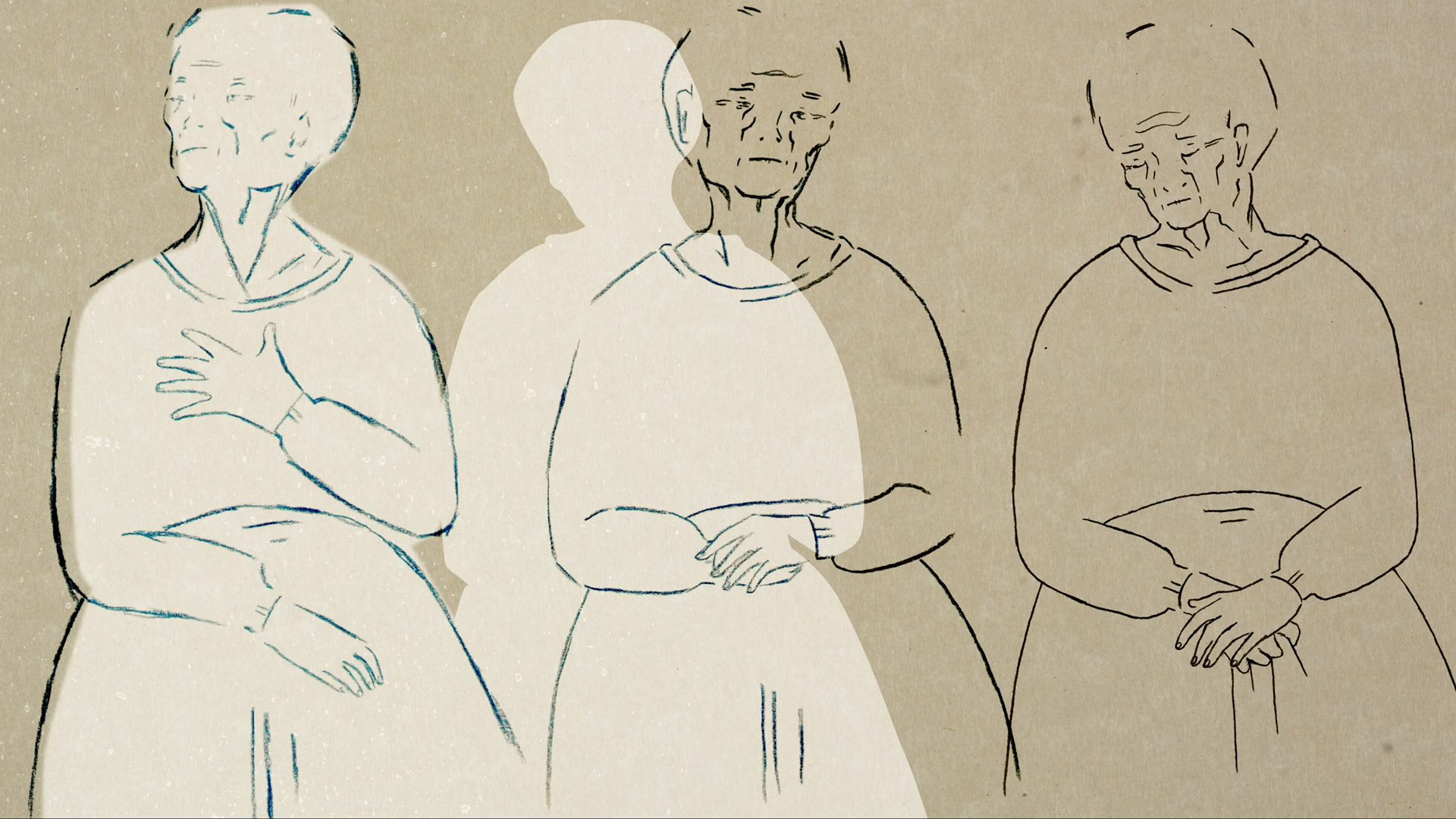

Sometimes a film doesn’t need to say much to say everything. That’s exactly what Aphasia, Marielle Dalpé’s haunting animated short, does—and in just under four minutes. This piece hit me hard, not just for its technical brilliance, but for how deeply it understands what it means to lose language but not love.
Dalpé created Aphasia as a tribute to her grandmother, who developed the condition after a stroke. Aphasia is a neurological disorder that disrupts a person’s ability to speak, read, or write—but what this film beautifully captures is how the essence of a person, their emotions, and their relationships can remain. It’s an ode to memory, disconnection, and the tenderness that can live inside silence.
The film premiered at TIFF 2023 and was also nominated for Best Animated Short at the Canadian Screen Awards. But beyond its accolades, Aphasia feels like a deeply personal gift—a transmission of something unspeakable, in the most literal sense. The animation is bold and fragmented: ink bleeds, gestures blur, and the visuals feel like they’re dissolving before your eyes. Watching it, I felt as if I was inside the condition itself—unmoored, reaching, straining to connect.
The sound design is equally disorienting: ambient tones and scrambled voices glitch and flicker in and out, mimicking the chaos of a brain struggling to process language. But amid the distortion, there’s a throughline of warmth. Dalpé said in interviews that her grandmother “never forgot that I was someone she loved”—and you feel that love pulsing underneath the abstraction. Even in the moments where words are impossible, feeling breaks through.
What’s especially powerful is that Dalpé doesn’t offer easy metaphors or neat resolutions. This isn’t a tidy arc. It’s a visceral experience. One moment, you’re floating through black and white stillness; the next, you’re jolted by ink splatters or piercing sound. It reminded me that animation, when done right, can go far beyond representation—it can put you inside someone’s world.
I was struck by Dalpé’s ability to blend emotional storytelling with avant-garde techniques. The visuals were all hand-drawn, using textures that emphasize decay and erasure. According to her NFB profile, she wanted to reflect the real experience of mental fragmentation—not to dramatize it, but to translate it through movement, rhythm, and mood. Mission accomplished.
For any of us working in short-form, Aphasia is a masterclass in emotional efficiency. It doesn’t explain—it evokes. It doesn’t guide—it immerses. And somehow, despite its brevity, it lingers like a poem you can’t quite shake. I finished watching and sat in silence for a long time. That’s the mark of something honest.
So, if you’re looking for a short that dares to push the boundaries of narrative, one that blends raw memory with tactile visuals and carries a deep emotional pulse, give Aphasia your attention. It’s a story about loss—but also about the quiet, powerful ways we stay connected.


