
A single image can carry a film for years. In The Girl Who Cried Pearls, that image is as simple as it is haunting: tears turning into pearls. What begins as a poetic idea slowly unfolds into something heavier—a story about love, memory, and the quiet, destructive pull of greed.
This Oscar-winning Canadian stop-motion short, directed by Chris Lavis and Maciek Szczerbowski, builds its world like a carefully preserved artifact. Rooted partly in Montreal, the film follows a poor boy who falls in love with a girl whose sorrow produces pearls. What starts as wonder quickly shifts into moral tension, as the boy begins to exploit that gift, setting in motion a choice that will define the rest of his life.
The structure itself feels like something passed down rather than invented. A story within a story, told by an older man confronting his past, gives the film a sense of distance—as if we’re not just watching events unfold, but listening to a confession shaped by time. That framing becomes essential. It turns the narrative into something reflective, where meaning isn’t just found in what happened, but in how it’s remembered.
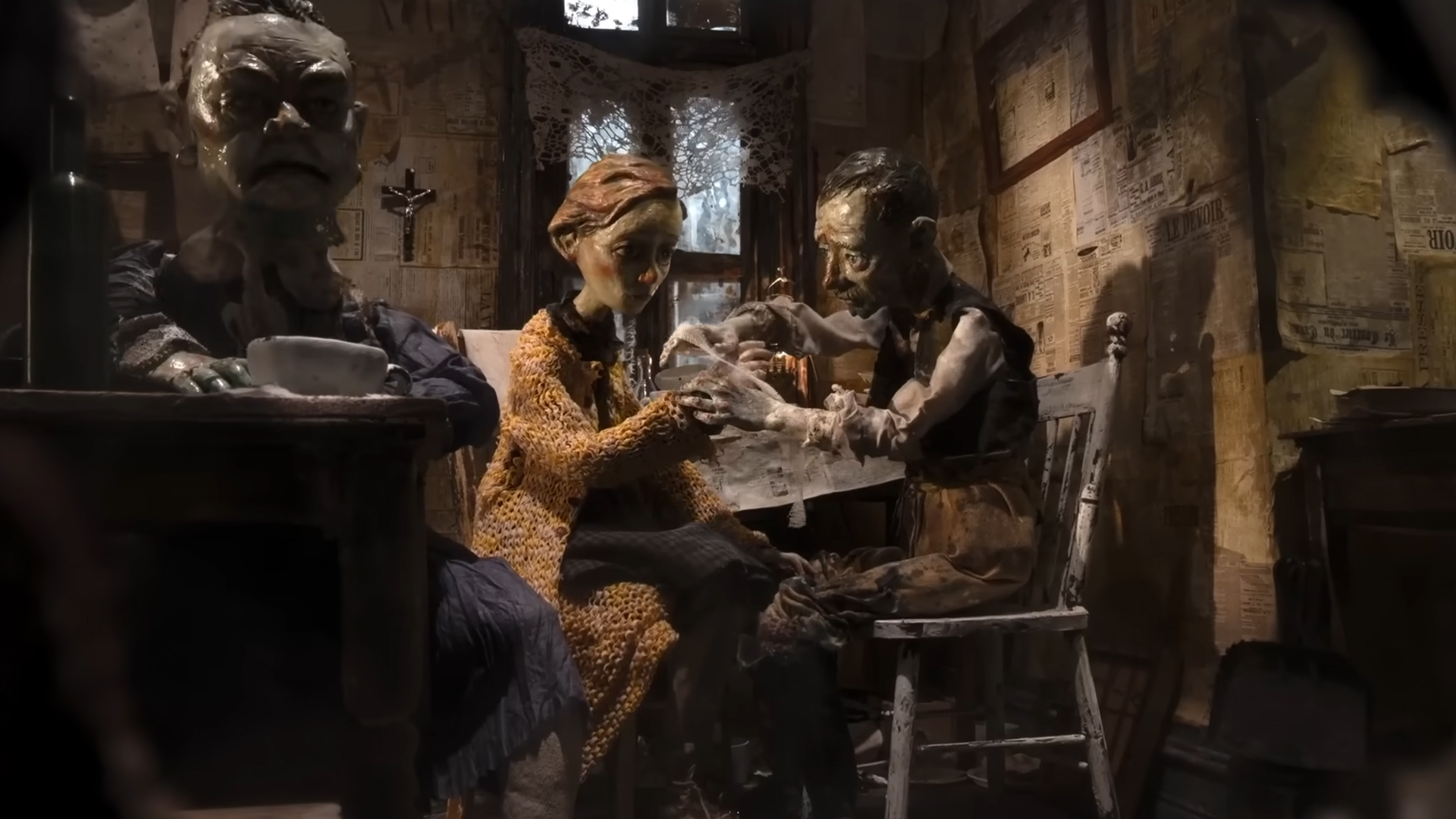
Visually, the film leans into the tactile nature of stop-motion in a way that feels almost obsessive. Every surface carries weight: weathered buildings, cluttered interiors, delicate fabrics stitched by hand. The puppets themselves are striking—serene, almost mask-like faces that don’t rely on expression, forcing emotion to emerge through gesture, rhythm, and light. It creates a kind of distance that paradoxically makes the film feel more intimate.
That attention to material detail extends to the filmmaking process. Much of the lighting and color work was captured directly in-camera, giving the film a painterly quality that avoids the polish of digital perfection. Even accidents became part of the aesthetic. Warped models, unexpected textures, and imperfections were embraced rather than corrected, reinforcing the sense that this is a story shaped as much by chance as by intention.
There’s also a quiet shift in approach here compared to the directors’ earlier work. Known for more surreal, dreamlike storytelling, Lavis and Szczerbowski lean into a clearer, more linear narrative this time—almost like testing what happens when their experimental instincts are applied to a traditional fable. The result feels balanced between two worlds: structured, but never rigid; emotional, but never overstated.
At its core, The Girl Who Cried Pearls is less about its central conceit and more about what that conceit reveals. It asks what we’re willing to sacrifice for value—how easily love can be reframed as opportunity, and how storytelling itself can transform something intangible into something precious.
By the time the film reaches its final moments, the pearls no longer feel like magic. They feel like consequence.