Hugo Canoilas’ work has always carried the quiet confidence of someone who has learned by moving—across cities, disciplines, and ways of seeing. Born in Lisbon in 1977 and now based in Vienna, Canoilas arrived where he is by design rather than inertia. Before settling, he lived and studied across Europe, absorbing different cultural rhythms, architectural languages, and social textures. That sense of movement still lingers in his work today: nothing feels fixed, resolved, or content to stay in one place for long.


Written by
Elliott Brooks
in
Dimensions
Art & Design
Hugo Canoilas and the Courage of Entering the Unknown
At the core of Canoilas’ practice is a resistance to flatness—conceptual, spatial, and experiential. Painting, sculpture, performance, opera, publication, and collective projects all coexist in his orbit, not as separate lanes but as overlapping systems. His work often feels like an invitation rather than a declaration. It asks viewers to step closer, linger longer, and reconsider their role in relation to the artwork itself. You don’t simply look at a Canoilas piece; you negotiate with it.
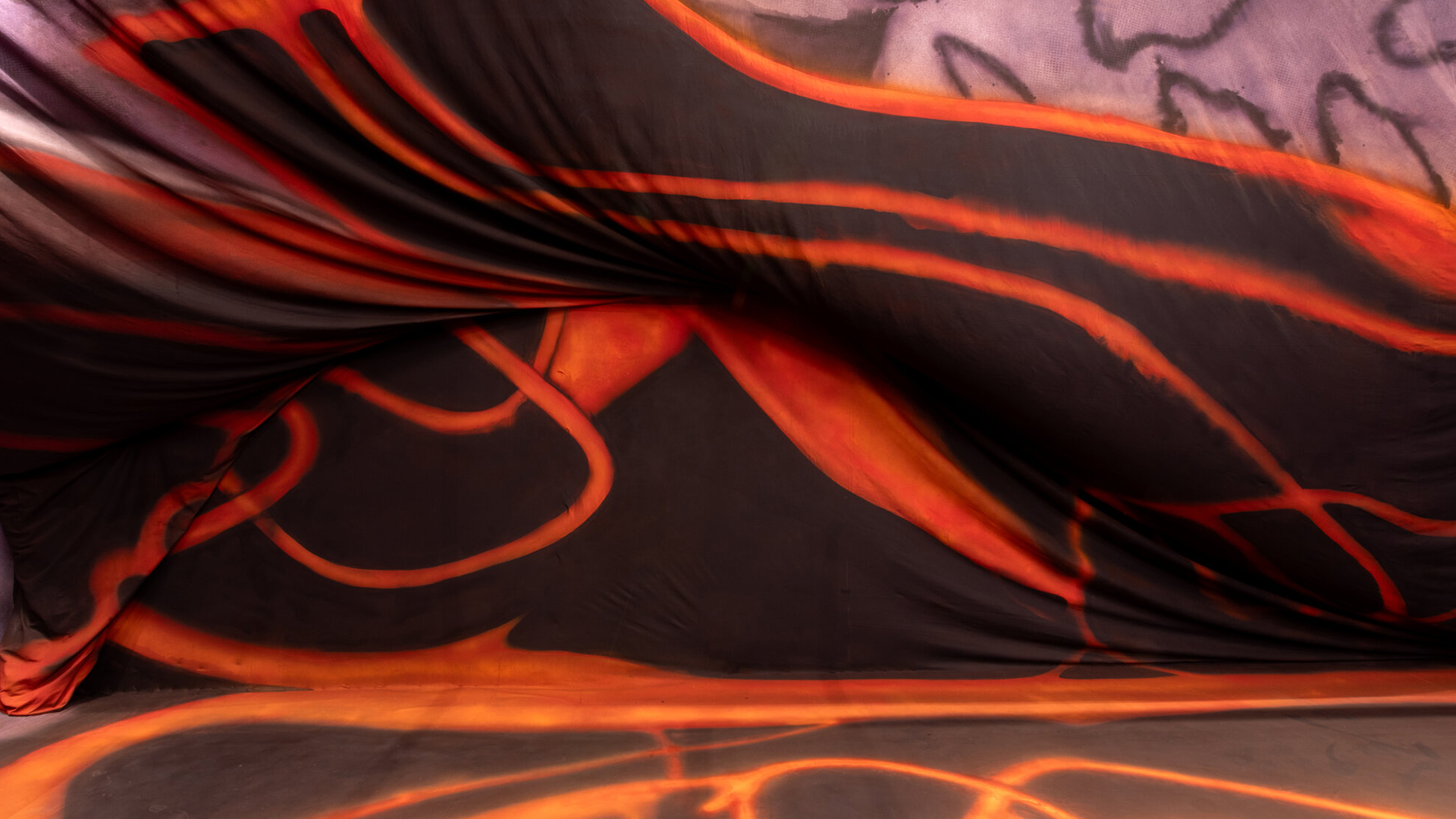
That philosophy becomes especially tangible in Hold Your Breath, Canoilas’ first solo exhibition in Canada, currently on view at Oakville Galleries. The exhibition centers on a monumental, amorphous painting that stretches across the entire Centennial Gallery floor, transforming painting into something architectural and bodily. Visitors are not positioned at a respectful distance; instead, they are encouraged to walk across the surface, guided by gestures, textures, and light. Painting here is no longer a window—it’s a terrain.
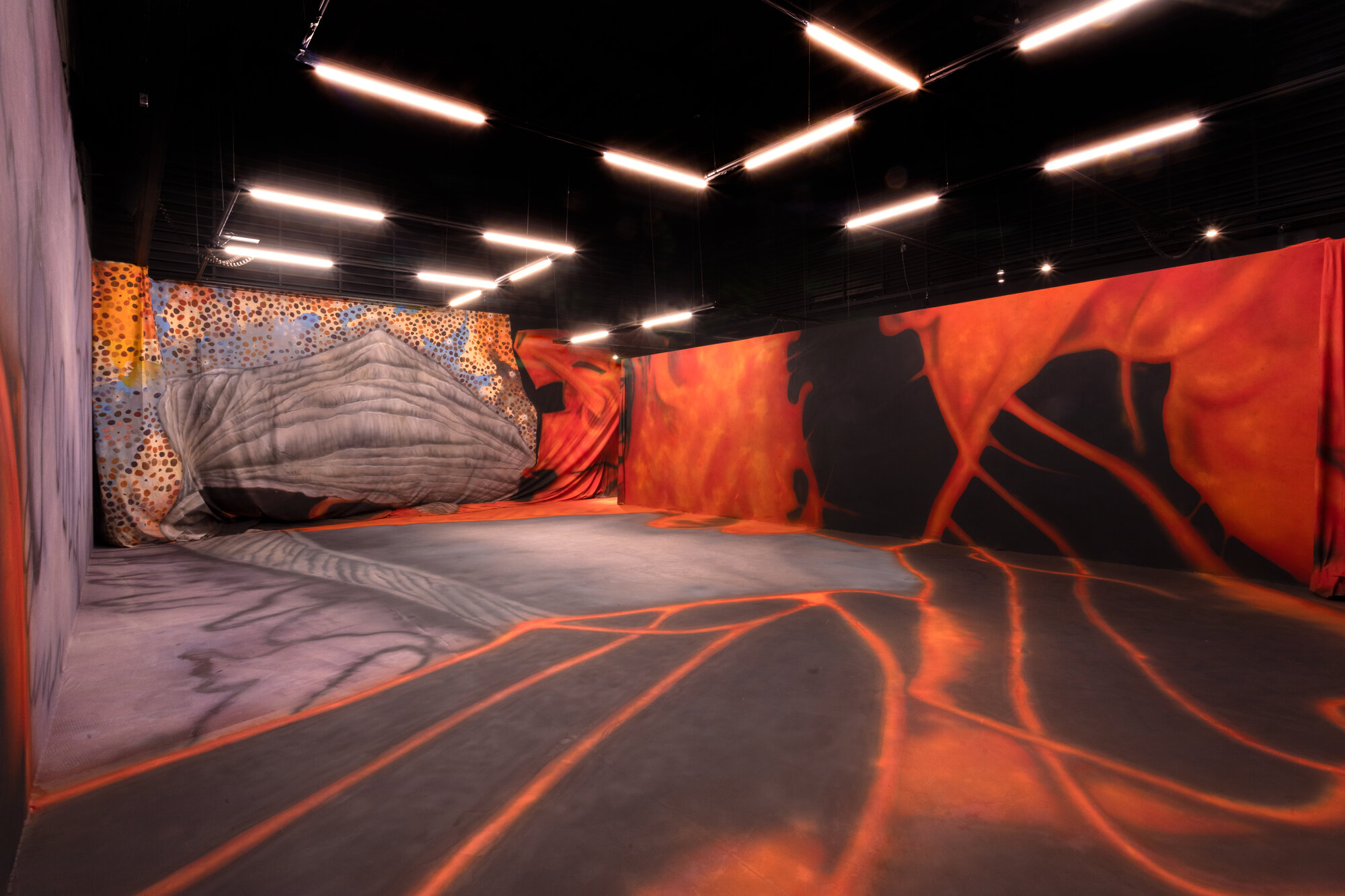
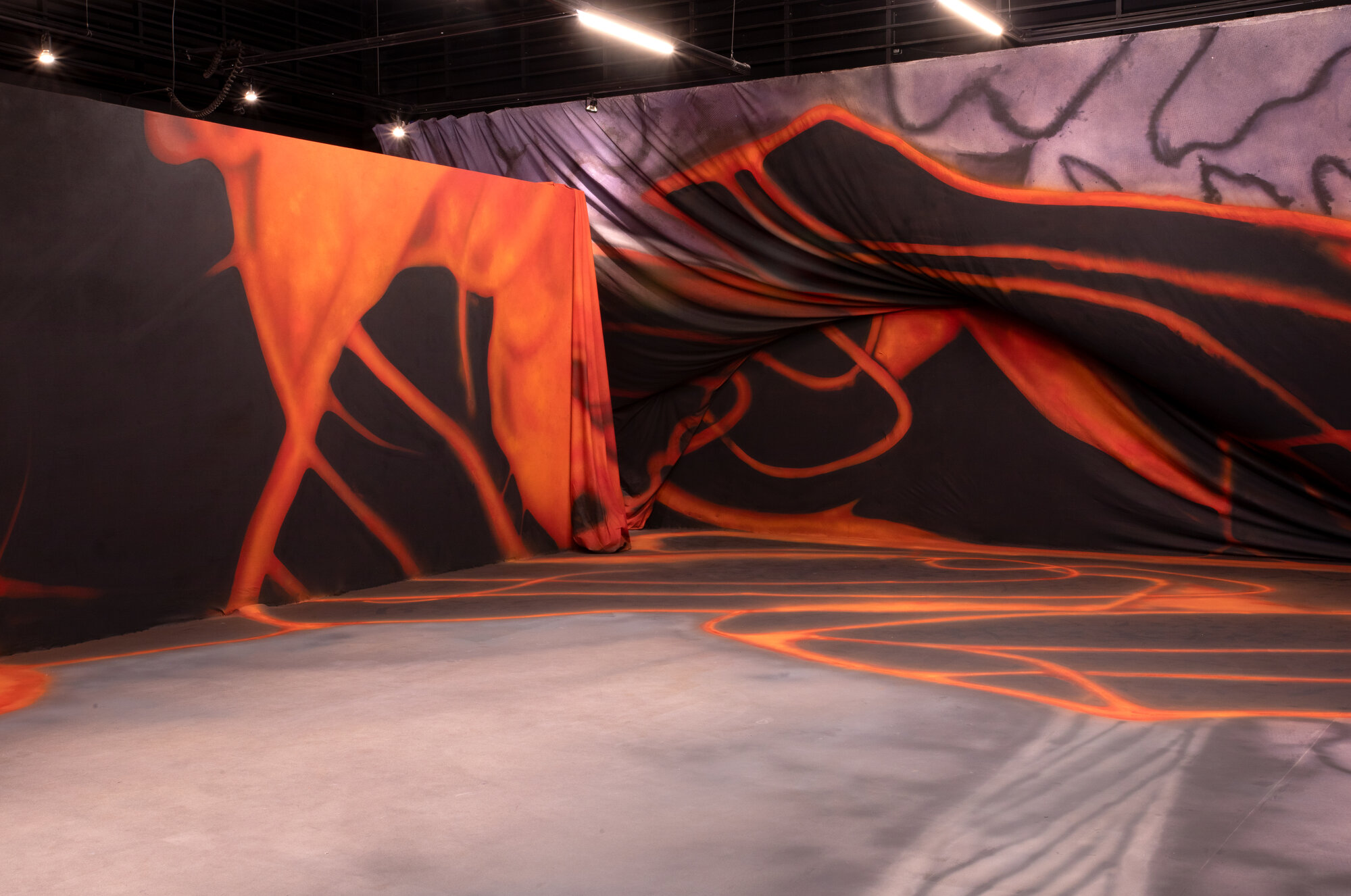
Originally conceived as an operatic set for Kunsthaus Bregenz and the Bregenzer Festspielhaus, Hold Your Breath has been reimagined for Oakville, reflecting Canoilas’ ongoing interest in revisiting and recontextualizing large-scale works. Traces of its previous life remain visible: scars on the canvas, markings from performance, evidence of a work that has lived elsewhere before arriving here. Rather than hiding these remnants, Canoilas allows them to speak, reinforcing the idea that artworks—like people—carry their histories with them.
Visually, the installation draws heavily from deep-sea imagery: octopus skin viewed at a microscopic level, seashells, siphonophores. These references aren’t decorative; they’re philosophical. The deep sea, largely uncharted and resistant to control, becomes a metaphor for collective uncertainty and interdependence. Images emerge from darkness slowly, recalling both the celestial lighting of historical painting and the stark whiteness of modernist galleries. The effect is immersive and disorienting in the best possible way.
Canoilas’ use of “expanded painting” pushes against traditional boundaries, dissolving the line between two- and three-dimensional space. More importantly, it alters the role of the viewer. Inside Hold Your Breath, perception becomes active. Movement matters. Choice matters. This approach echoes earlier projects like A Gruta and Under the Volcano, where Canoilas invited audiences to take part in shaping their experience of the work. Agency, here, is not symbolic—it’s spatial.
Beneath the sensory richness lies a deeper ethical concern. Canoilas’ engagement with ideas of symbiosis, multitude, and shared agency reflects a broader political awareness. The installation subtly counters ideologies of isolation, fear, and purism, proposing empathy, interconnectedness, and openness as alternatives. Rather than illustrating these ideas directly, Hold Your Breath creates conditions in which they can be felt—physically and emotionally.
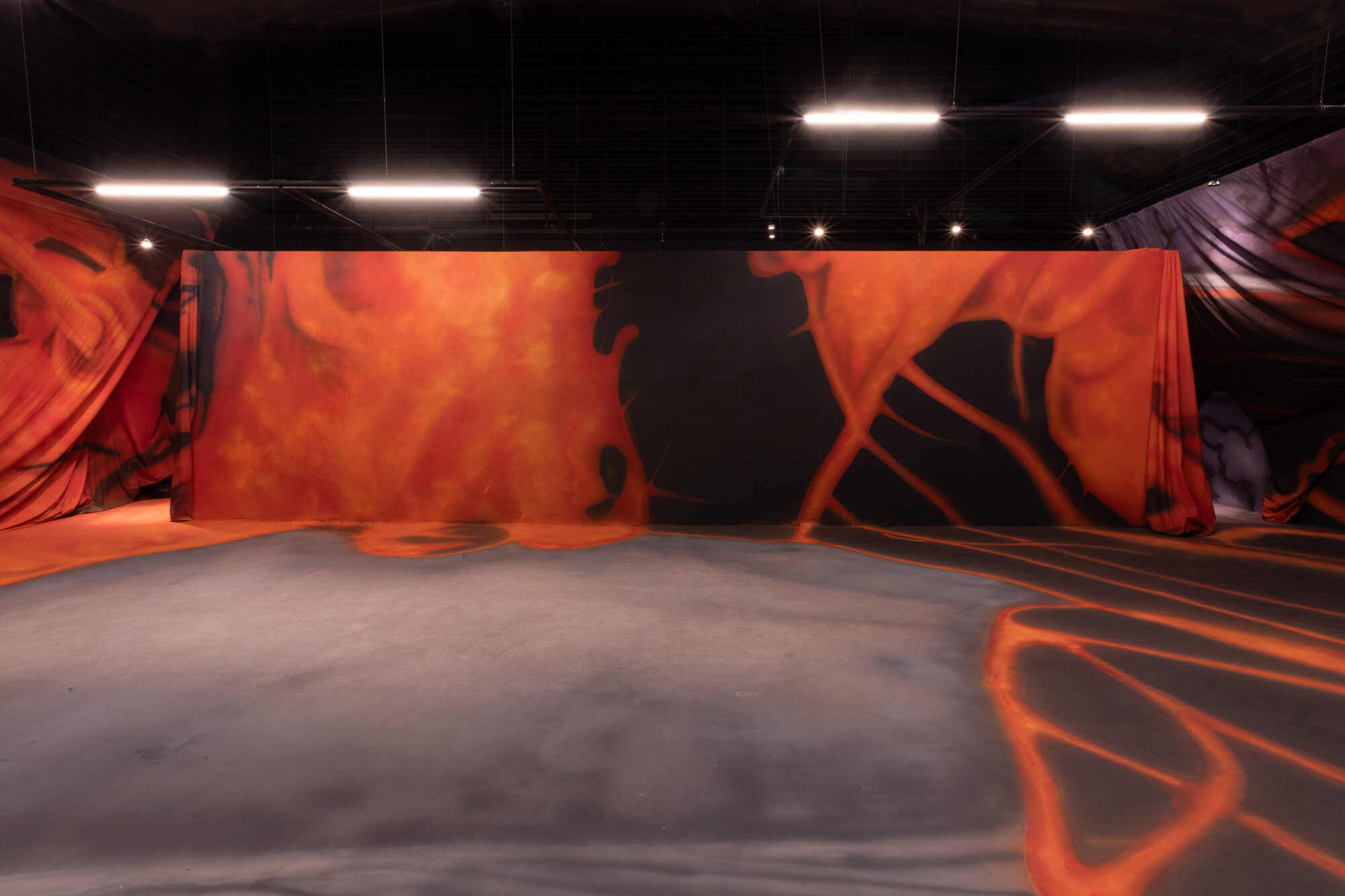
To experience Hold Your Breath is to accept uncertainty, to move carefully through darkness, and to trust that meaning will surface in time. It’s an exhibition that doesn’t rush you toward answers, only toward awareness. You can learn more about the exhibition and plan your visit through Oakville Galleries.
All photos by Jimmy Limit.