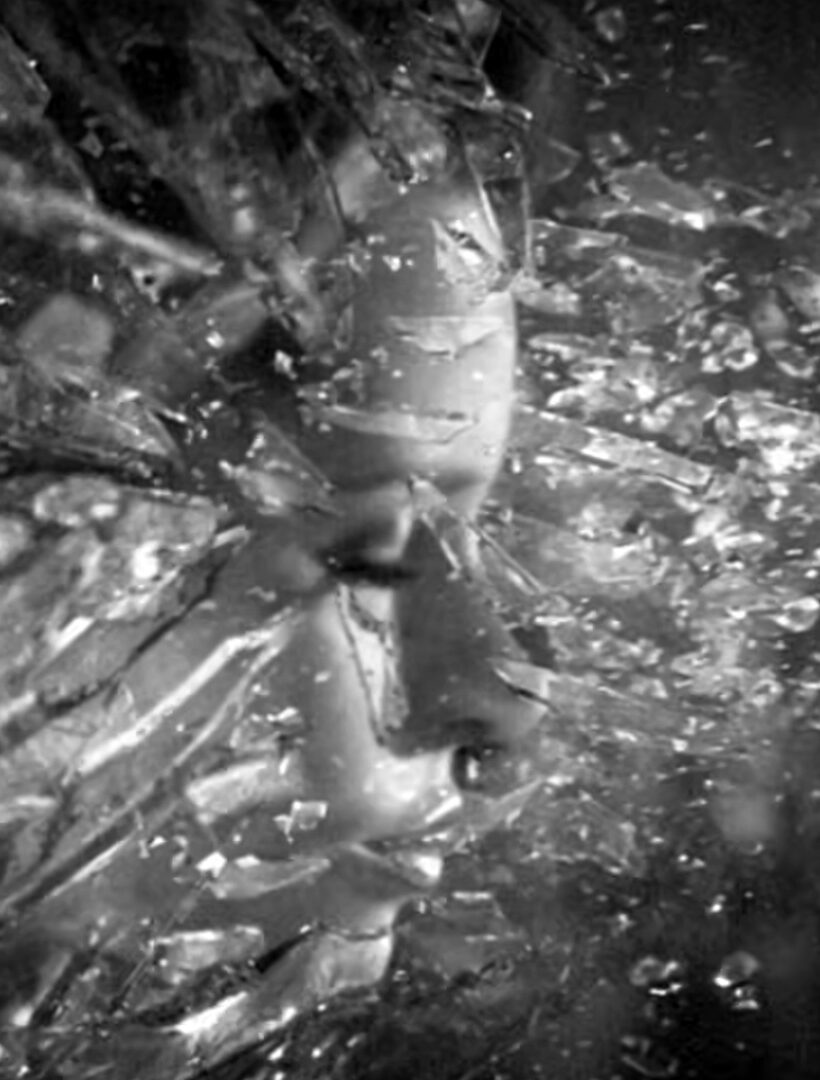

Confined spaces have a way of amplifying everything — discomfort, prejudice, silence, fear. /HAAW/ understands this instinctively. Set almost entirely inside a ski gondola, the short strips communication down to its most fragile form and asks what happens when difference is met not with curiosity, but with mockery.
The setup is deceptively simple. Two snowboarders, Brett and Jacob, step into a gondola for what should be a routine ride up the mountain. Already inside is a strange, otherworldly family who communicate using only a single, repeated sound: “HAAW.” As the gondola climbs higher, the isolation sharpens. There’s nowhere to turn away, nowhere to escape, and no shared language to smooth things over.
What unfolds is uncomfortable by design. Brett, in particular, responds to the family’s presence with ridicule and open hostility. His behavior isn’t subtle, and it isn’t softened by irony. The film allows his bigotry to sit plainly in the frame — not exaggerated into caricature, but presented as something painfully recognizable. The humor lands early, but it’s edged with unease, the kind that creeps in when laughter starts to feel complicit.
The brilliance of /HAAW/ lies in how it treats communication itself as both subject and structure. The repeated sound becomes a provocation, a mirror, and eventually a reckoning. What Brett dismisses as absurd noise carries meaning he refuses to consider, and as the tension escalates, the film pivots. Without spoiling its final turn, /HAAW/ reveals that misunderstanding isn’t harmless — and that refusing to listen has consequences that extend beyond discomfort.
The film was written in response to the growing normalization of xenophobia and exclusion, and that motivation is felt in every beat. Rather than delivering a moral speech, /HAAW/ stages its conflict inside a shared space where power, fear, and prejudice have nowhere to hide. The gondola becomes a pressure chamber, forcing attention where avoidance would usually take over.
Developed through a Seed&Spark campaign, the project embraced abstraction and humor as tools rather than shields. Critics have noted how the film balances comedy with confrontation, allowing the audience to laugh before realizing what, exactly, they’re laughing at.
/HAAW/ doesn’t offer comfort. It offers clarity — a reminder that attention is an ethical act, and that listening is often the first line between coexistence and harm.