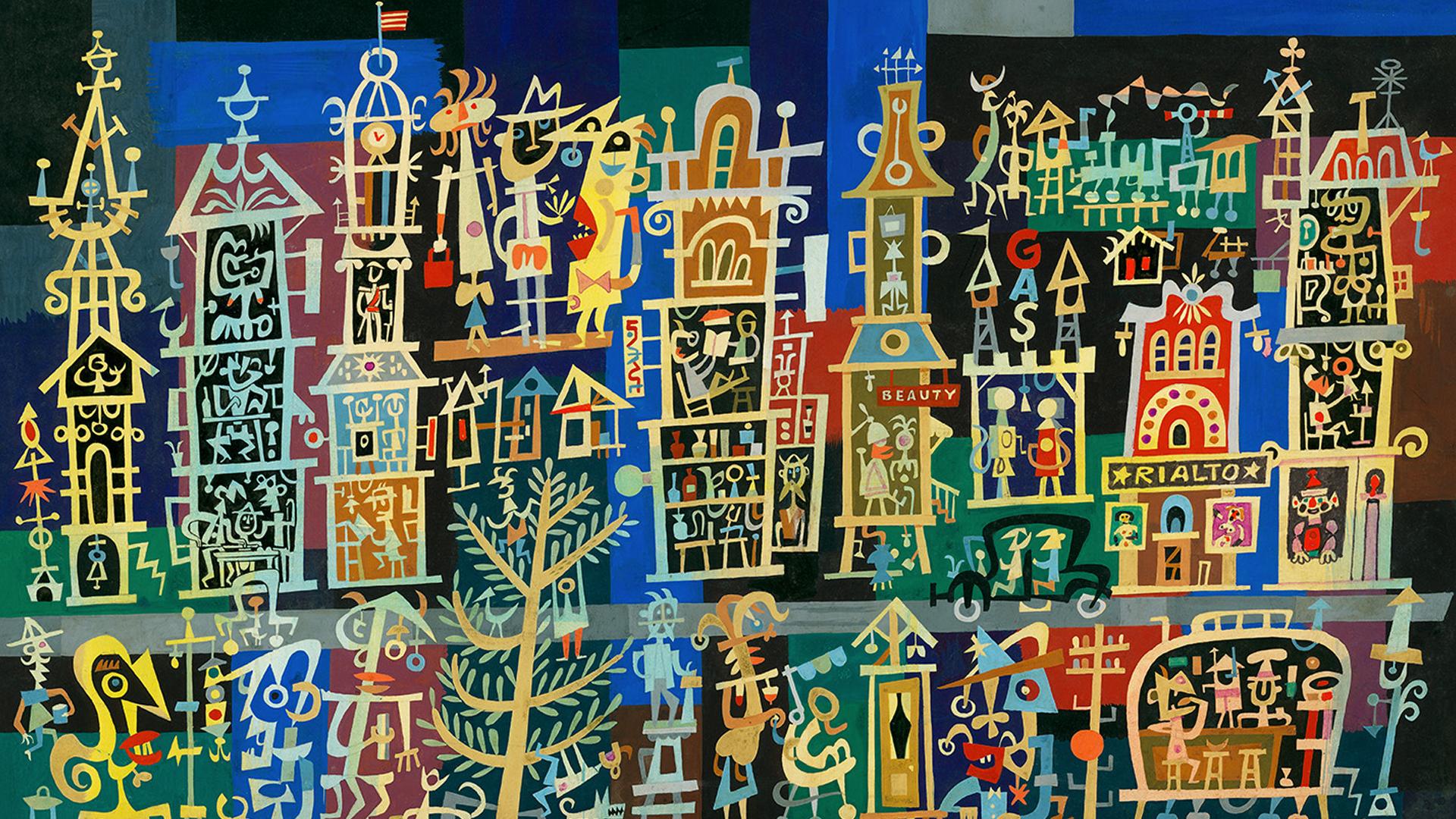
Jim Flora: The Wild Rhythm of Mid-Century Art
Elliott Brooks
Written by Elliott Brooks in Dimensions Art & Design Creative Music

Jim Flora: The Wild Rhythm of Mid-Century Art

If you flick back through the history of American illustration, there are the slick, photo-real covers — and then there’s Jim Flora, the guy who grabbed his brush, tuned the jazz, and said “let’s redraw the rules.” Born in 1914 in Bellefontaine, Ohio, he eventually studied at the Art Academy of Cincinnati and then zoomed into the world of commercial art, only to crank it through a filter of cartoonish absurdity and vivid color.

Flora’s early breakthrough came in the same era vinyl records became cultural artifacts. When the record-jacket was still a novelty, he stepped in at Columbia Records and later RCA Victor with album covers that look like a collision between bebop, abstract modern art, and a kid’s sketchbook gone wild. One classic: “Mambo for Cats” (1955) — chaotically fun felines playing brass, teeth flying, bodies twisting, in colors that pop like a record needle hitting the groove.

Mambo For Cats, album cover by Jim Flora
Bix And Tram, album cover by Jim Flora

His style? Think angular hepcats, shark-fin chins, instruments doing backflips. Flora described hearing jazz as not occupying his mind but his “blood vessels.” He used that energy to fuel visuals that seemed to wobble just slightly off-kilter — like the world had tilting basslines and unexpected echoes. It was playful, but laced with weirdness. Kids’ book illustration, magazine work, fine art painting — he covered it all, never quite conforming.

What thrills me about Flora is his fusion of craft and delight. He could sketch a cartoon, then flip it into an album cover or a children’s book. His children’s book career spanned 17 titles between the 1950s and early ’80s, showing the same mischief but in gentler mode. In his paintings later in life, nautical themes and vibrant chaos merged: a steamboat might drift across a neon sea, or figures might stand frozen in a carnival-flux moment. The craft was slick; the spirit stayed wild.

Here’s a tip for modern creators (and yes, I’m talking to you): Flora shows us that design doesn’t have to be safe. He shows that humor, pattern, distortion, weird scale — used thoughtfully — can speak louder than conventional elegance. He took jazz’s break-neck rhythms, ran them through graphic design, and came out with a set of visuals that felt immediate, electric, but deeply personal.

Chioggia, by Jim Flora
Scroll