Roberta Bondar: Earth from Orbit, Life from Light
Zoë Marin
Written by Zoë Marin in Beyond the Frame Photography

Roberta Bondar: Earth from Orbit, Life from Light

Roberta Bondar’s photography asks us to see our planet not just as place, but as pulse—alive, fragile, and endlessly expansive.

Most people know her as Canada’s first female astronaut and a neurologist. But for Bondar, flight was just part of a longer journey—one that always included landscape, science, and that quiet but insistent voice of wonder. In 1992, aboard the Space Shuttle Discovery, she was part of NASA’s Earth Observation Team, photographing Earth through portholes and telescopes. That vantage point left a mark. After returning, she didn’t step back from nature; she leaned into it harder.

Sunlight and shadow in Kluane National Park and Reserve in the Yukon. (Roberta Bondar/Canadian Geographic)

Bondar’s photographic work spans deserts, Arctic ice, national parks, and migratory bird routes. She uses large- and medium-format cameras on the ground, aerial images, and even satellite and space-based observation to frame Earth’s edges—from flamingos in African rifts to icebergs under long dusk in the North. But she also zooms in: flowers, forests, granite cliffs, the curve of a coastline, reflections on water. The tiny and the vast, both threaded through her lens.

The Ward Hunt Ice Shelf on the north shore of Ellesmere Island. (Roberta Bondar/Canadian Geographic)

A latest travelling exhibition, Patterns & Parallels: The Great Imperative to Survive, brings together images of threatened bird species and their migratory corridors. The work collates three perspectives—surface, aerial, and space—to show how habitats, flight paths, and Earth’s changing face intersect. There’s a gravitas in how she layers these views: a crane or flamingo might appear small in one frame, monumental in another, and ethereal in space-born maps. What carries across all scales is urgency—the responsibility of seeing what might be lost.

Bondar’s technique reflects her dual life as scientist and artist. As a young photographer she trained using fluorescence, electron microscopy, and craft-based printing methods; today she marries technical precision with poetic framing. Colors are rich but controlled. Light doesn’t just illuminate—it sculpts. Her landscapes are not passive; they ask us to inhabit their edges.

In Canada—where geography can stretch forever but climate and ecosystems are increasingly under pressure—Bondar’s work feels especially essential. An exhibition marking the 25th anniversary of her space mission revisited the Earth she first saw from orbit—not to romanticize, but to re-inscribe that moment of perspective into current debates: conservation, biodiversity, environmental ethics.

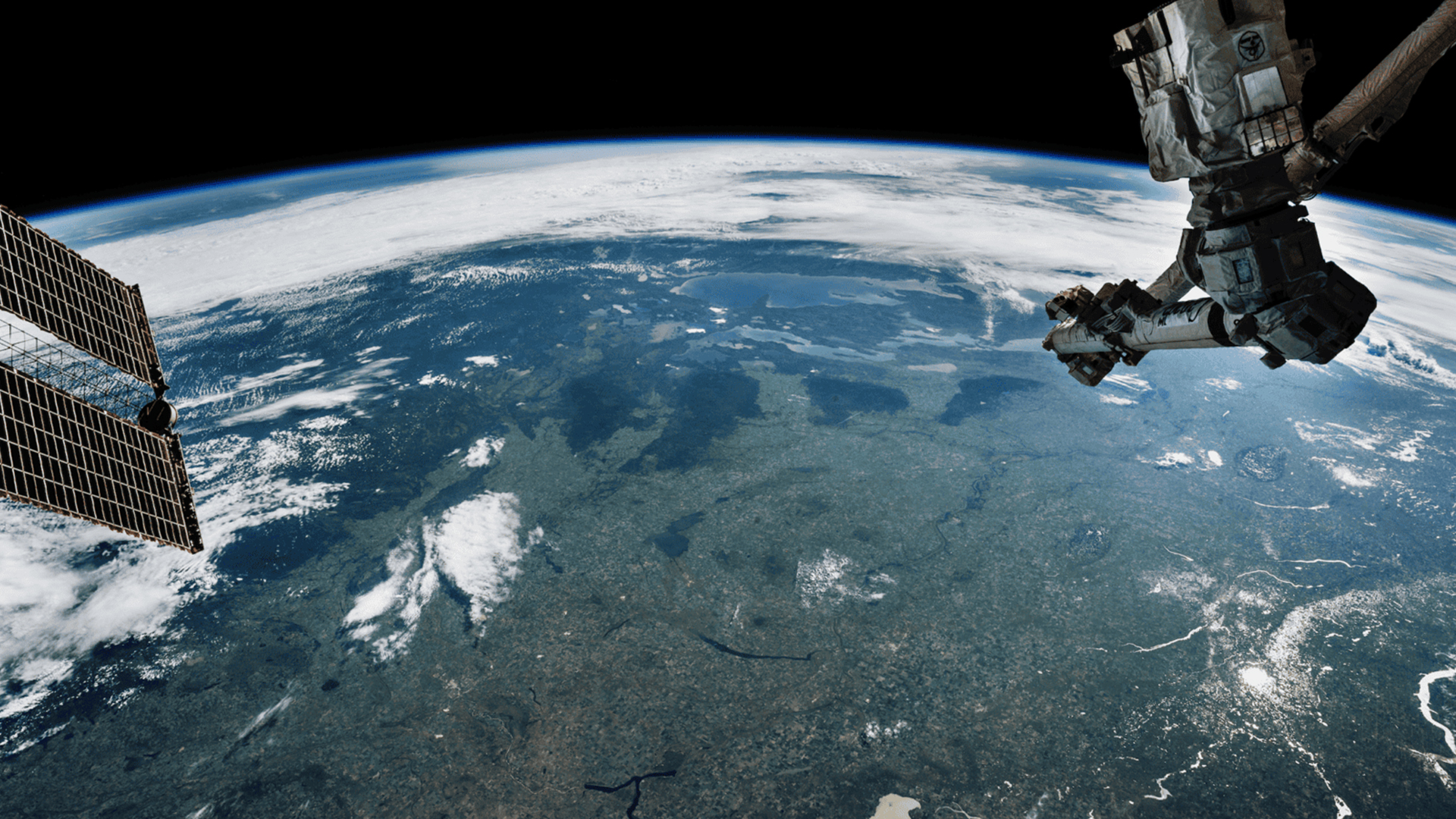
What makes her images more than beautiful is the way they operate at multiple scales. They remind us that the macro informs the micro: what we do in deserts, wetlands, skies, ice fields matters. And that every ecosystem, every mating pair of birds, every ragged coastline is part of a larger story we can still choose to tell well.

Lake Elementaita Phoeniconaias minor. (Collection of the Roberta Bondar Foundation)
Scroll