Murray Fredericks: Mirrors on the Salt Sea
Zoë Marin
Written by Zoë Marin in Beyond the Frame Creative Photography

Murray Fredericks: Mirrors on the Salt Sea

Standing alone on the endless white salt pans of Lake Eyre, Murray Fredericks doesn’t just photograph a landscape — he collaborates with it. Fredericks is one of Australia’s most respected contemporary photographers, known for his large-format images that transform remote places into meditative visions of space and time. He’s not chasing drama or spectacle — he’s chasing the stillness that reveals itself when you stand still long enough.

Fredericks’ best-known body of work is his decades-long series on the Kati Thanda–Lake Eyre salt flats in South Australia. Here, the horizon runs unbroken for miles; the sky and ground blur into one boundless plane of light, salt, water, and air. It’s this intersection — where sky meets land in a fragile mirage — that Fredericks returns to again and again.

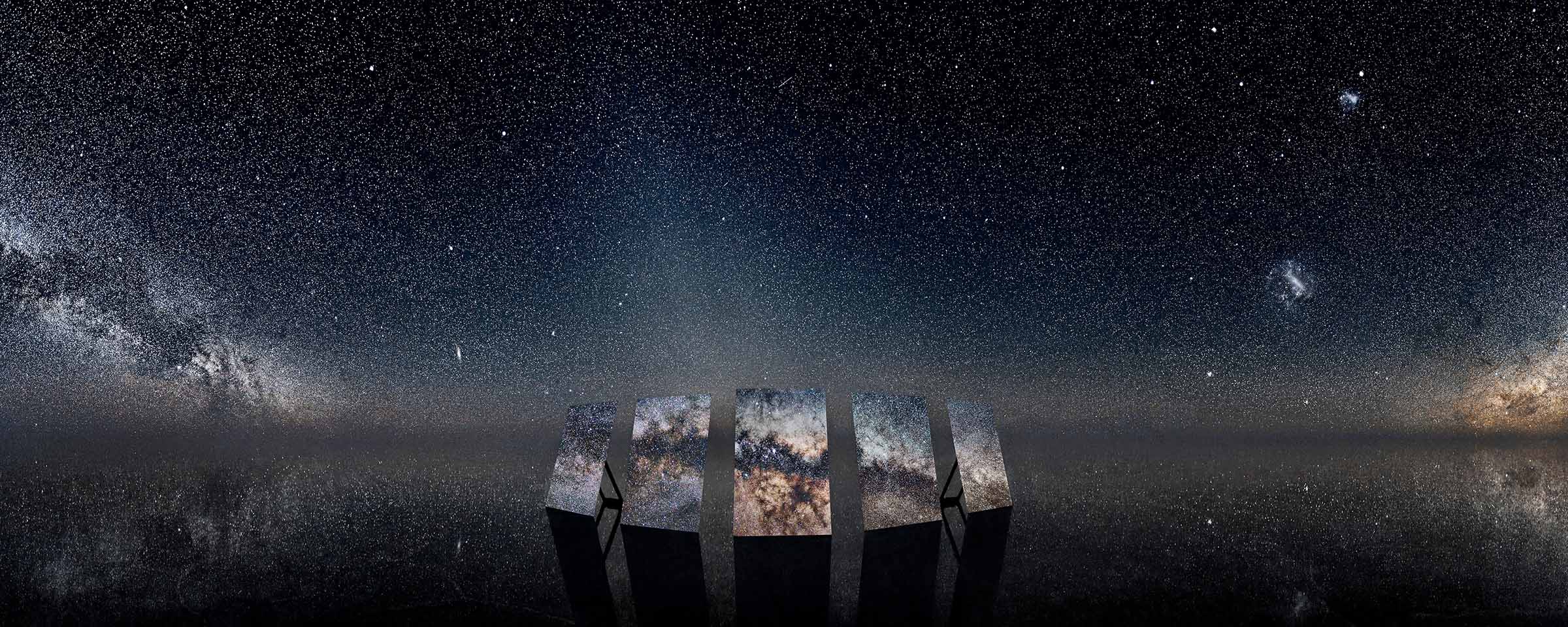
In his Array series, Fredericks installs a ring of mirrors on the salt pan, fracturing the sky into shifting geometries that blur the line between reality and reflection. These mirrored arrays turn the vast emptiness into a living stage for light and weather — an elemental collaboration where the horizon endlessly reinvents itself.

Murray Fredericks. Salt 108, 2006

Working in such isolation demands more than technical mastery — it demands patience and surrender. Fredericks often camps alone for weeks, contending with searing sun, unexpected floods, or bitter winds that can wipe away days of preparation in a single gust. His images hold that devotion in their silence: a record of moments where weather, light, and the artist’s own endurance align.

Fredericks’ practice pushes landscape photography into the realm of quiet metaphysics. You feel the passing of time in these frames: clouds drifting, storms forming, light bowing toward dusk. It’s minimalism without sterility — a place where precision coexists with the unpredictable movements of the natural world.

Beyond Lake Eyre, Fredericks has also turned his lens toward the Greenland ice cap and other remote terrains, but it’s the salt flats — harsh, hallucinatory, and humbling — that anchor his vision. These works remind us that sometimes the most profound images are born not from exotic drama but from an artist’s willingness to wait — to really see what a place has to say.

Murray Fredericks. Array #1, 2019
Scroll